Love or Loyalty? When your heart is divided: A review of A Suitable Boy and Love + Hate

In a battle over family or love what would end up winning for you?

Most people envision falling in love with people that their family would approve of. But when the chips don’t fall that way (since life always has other plans, after all) – what do you do? Do you risk it all for love or sacrifice that love for your family?

This theme is explored in two things I watched recently; A Suitable Boy and the film, Love + Hate.

A Suitable Boy – the gist:
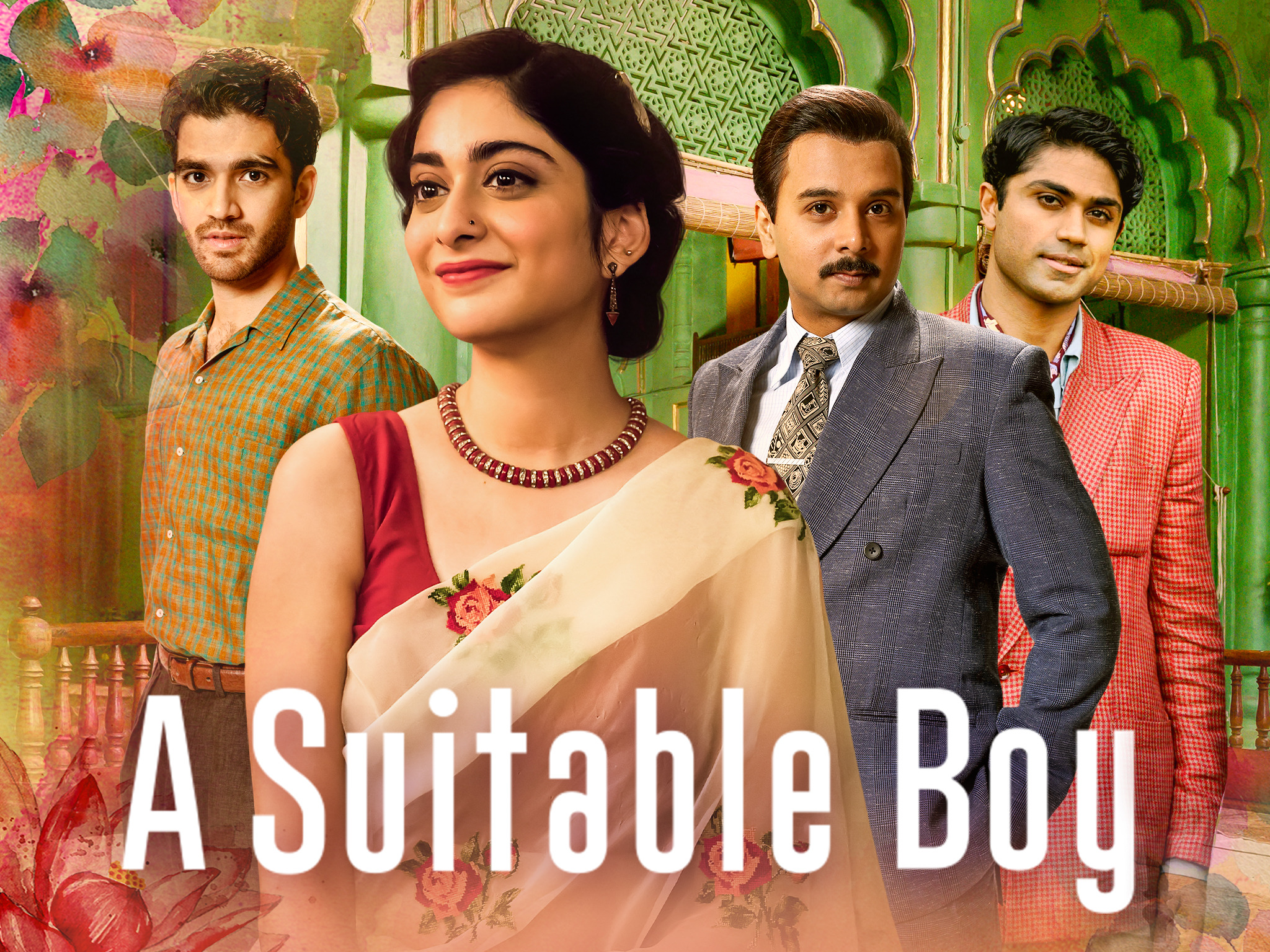
Series poster with Lata (centre) and her suitors

A Suitable Boy (2020), is a historical BBC drama series based on the popular book by Vikram Seth. It follows young female student, Lata who falls in love with dashing fellow student, Kabir. It’s set amidst the backdrop of 1960s India, so many political events are taking place in the background which fuel lots of the events in the drama. With one of the key events being India’s first general elections, which are slowly approaching.

It starts of with a typical boy meets girl scenario at an Indian university. Lata plays hard to get but Kabir is entranced and determined to win her over. He succeeds soon enough. However, there’s an issue – Lata is Hindu and Kabir is Muslim. The two religions do not get along, yet alone marry, so she knows there’s no way she’ll get her mother’s blessing for the relationship. She battles with this throughout the series, especially as her feelings for Kabir grow. Her friend initially against it does eventually tell her to go for it, but her mother is determined to stop the relationship in its tracks by arranging a marriage for her. To make things juicy, as episodes go on, she attracts – along with Kabir – not one but two additional suitors vying for her heart! Bridget Jones could never. The other two suitors are strong candidates; Amit Chatterji – wealthy and eligible bachelor who is also a published poet, and Haresh Khanna, a British educated shoe maker determined to settle down.

Thoughts

I loved all the characters in this drama – not because they were likable but because they were well fleshed out. It didn’t shy away from exploring themes of religious conflict and violence; something that was ultimately crucial to authentically cover this period of time.

I’m not sure how the book ends but in terms of the suitor Lata chooses in the end, I was quite surprised by her choice. Firstly, you do get the slight sense that Lata would prefer not to be married. She’s a teen who is in love with learning and realistically, probably would have thrown herself into more studies if it wasn’t for the social expectation that she can’t do so – she has to choose marriage instead. There’s also many points in the series where it seems her mum is very much keen to marry her off more than Lata herself wants to get married. Her mum being a widow is an important factor in all of this – it feels, perhaps that she can live vicariously through the new relationships of her children. The engagements and weddings provide her with joy after long grieving her husband and, perhaps, feeling lonely herself.

I had some issues with the series’ ending. The suitor ultimately chosen didn’t seem on brand for the Lata I had grown to know and become fond of throughout the show. It also felt like, she didn’t exactly tie up the loose ends with her other suitors either – she just chose one to be with and went on her merry way. Bit of underwhelming breakup/goodbye considering that she spent 75% of the series talking about them, being with them or thinking about them. But I digress.

Love + Hate: a gist

Next up we have the film, Love + Hate (2005). This is set in Britain and centres on the love story of two teens, Naseema and Adam. They start of working together in a DIY shop with a fairly quick attraction forming. Yet, because this is a film, this attraction can’t be straight forward. In fact, Adam is not a fan of Asians (also known as being a racist), so although attracted to Naseema, he refuses to interact with her. This means he often ignores her questions and even has the audacity to demand that Naseema is fired by the store manager. She’s oblivious to the hostility though, often trying to make conversation and giving him flirty glances here and there.

Like A Suitable Boy, the backdrop is one of great social division – this time along racial lines; with a large anti-Asian and Islamophobic movement active in the area. Adam’s family is bigoted, blaming Asian immigrants for various problems in the area. His mum rants for instance about how her tanning bed business is being threatened by new Asian owned businesses that have opened up the road. He and his brother are very vocal about not wanting to ‘mix’ with the Asian demographic of their city. There’s a scene when they’re at the pub with friends and all jokingly talk about how they would never date an Asian girl. Then one lad in the group disagrees saying actually he would date one – he finds them to be very attractive. He’s met with violence, shouting and is forcefully kicked out the pub and the friendship group. Such is the high penalty for breaking the mold and being a decent human being.

Overall, this was an interesting film but by no means compares to A Suitable Boy. The build up and dating period between Naseema and Adam could have been fleshed out a bit, I think. I wish we saw more banter and conversation between them as they got to know each other. But because it was a ‘forbidden love’ they often had to meet in dodgy locations and for short amounts of time to avoid being caught by people from their respective communities. This didn’t give much opportunity for their chemistry to grow or shine for those of us watching. I’m also not a fan of this implied idea of people being able to ‘love away their racism’ since I don’t believe that’s possible, so it seems ever so slightly irresponsible to encourage that, even if it’s promoted subtly. Adam, who has grown up a bigot and raised with racism embedded values, suddenly falls in love and is suddenly no longer racist? Something tells me that’s not how that works…

Anyway, my overall ratings for both? A Suitable Boy – 8.5/10; strong series and cast just let down slightly by its ending and lack of tying of loose ends. Love + Hate – 7/10 – very gritty and rooted in an idealistic optimism I find it hard to get on board with.
The Cinema is Changing

The cinema is a magical place.

Even when I was younger, I thought this and the awe it inspires remains.

That feeling of taking a seat in the dark, clutching popcorn and a cold overly sugary drink – then letting yourself fall into the hands of a director as you step into the world, they’ve crafted in a production is unmatched. Yes, sometimes you may leave a little confused and/or disappointed (as is the case more and more often these days!) but that initial spark of excitement still remains regardless of the outcome.

As an adult in particular, I like that I have a reason to switch off my phone and dive into another world – even if it’s momentary. No distractions in view – just you and the film.

But. But. But.

WHEN DID CINEMAS START GETTING SO EXPENSIVE?? 😭

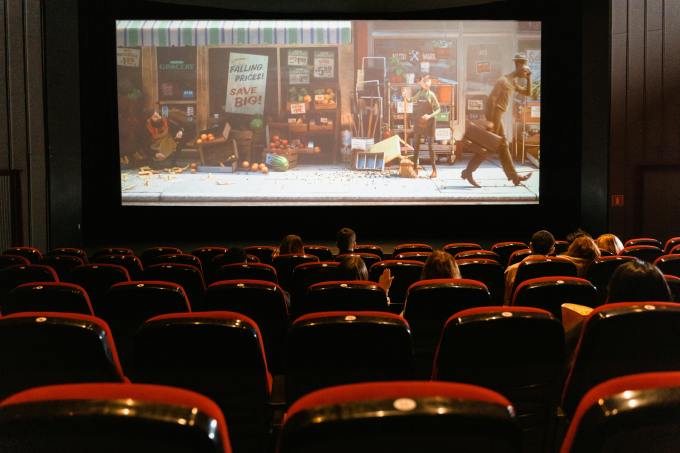
Going to a cinema in South London to watch The Colour Purple earlier this year, I was dumbstruck at how much I had to fork out. Between my friend and I, we paid £60.00 overall – half spent on the tickets and the other was the total expense for food. The price almost made me sick. It’s interesting this has become the case, considering that cinema, in my mind anyway, has always been a cheap form of entertainment for the masses.

And I’m aware many cinemas had a very tough time during the pandemic, so I wonder if this inflated pricing will compensate for this loss and slowly build back their status. Yet, it sucks they have to do this at the customer’s expense. These days even if it’s a film I know I would enjoy, I have to question if I really want to splash the money to do so. Or am I happy to wait a year before it’s shown on TV, or wait a few months until it inevitably hits streaming platforms?

This ranting post was inspired by me looking online recently at tickets to watch a film and being quoted nearly £20.00. Keep in mind if you buy snacks (sometimes sneaking them in doesn’t work!) you’re looking at spending around (£10 -12 more.) As you suspect – I looked at the price, blinked, and then closed the tab again.

Looks like the cinema won’t be seeing me for a while then.

______

Are you a cinema lover? What was the last thing you saw?

———————————-

Photo by Tima Miroshnichenko

 Art is in the eye of the beholder: American Fiction – An honest review

I watched this film the other day, which had magically landed on Prime – a relief for me who, just a few weeks ago was about to fork out money to watch in the cinema. Since it won an Oscar this year (Best Adapted Screenplay) my expectations were naturally high – why not read on to find out if they were met 😉.

This film centres around academic, Theolonious (let’s call him Theo for short). Like most academics he writes books for income, as well as lectures. The problem with his most recent book idea? It hasn’t been picked up by publishers. At the start of the film, we seem him arguing with his colleague who boasts that in the time it’s taken Theo to write one book he’s published several.

At some point, he comes across author Sintara Golden, (played by Issa Rae), who has written a book which is received much praise. He scoffs, since he feels the book is stereotypical and essentially beneath him. But later, primarily as a joke, he decides to write a similar book. He leans on racial stereotypes to create a novel which he thinks as a Black man, the world would expect him to write, but which he refuses to. The problem is, it’s floated past publishers and they LOVE it. What unfolds next is an amusing unravelling, as Theo is forced to ride out his lie, the more popular this book – which he doesn’t even like – becomes more popular in the literary community.

My take

There’s so much to dive into around this film – it makes rich material for a post-film discussion, I would say. A key theme that runs throughout is if it’s possible to be a successful artist and not compromise on your vision. The author Sintara’s book has received much acclaim for a book which focuses on what would be seen as stereotypically Black content. In other words features what Blackness might look like from a white perspective. When we hear her reading out an excerpt of the book at an event Theo is at, it’s in a broken type of English, reminiscent of Celie’s voice in The Colour Purple. An indicator that her Black characters are uneducated.

Her book’s acclaim, Theo would very much like to have but as a novelist who refuses to compromise, he doesn’t (much to his agent’s anguish). Well, that’s until his satirical novel unexpectedly takes off! There’s an interesting scene with Theo and Sintara which captures this theme well. Where he asks her about her book and what he sees as is ‘Black trauma porn’ nature. She eventually says something along the lines of – ‘you have to give the people what they want’. What I took from that, if you’re an artist living under capitalism and your art is your income, unless incredibly lucky in some way, it’s unlikely you’ll be able to create art that just pleases YOU. You’ll have to be thinking about the demand for your art and audience; all of which will dictate how it’s received. Essentially, you’re creating a product.

In the same scene with Theo and Sintara – Theo confides to Sintara that he wasn’t a big fan of her book, simply because he feels like it leans into a singular narrative told around Black people that he feels is overdone. There’s so many other experiences to write stories about! Sintara points out, that she actually put a lot of hard work and research into the book. Plus, Black people do suffer, so that narrative will always need to be told, and in doing so relate to many. I found this to be an interesting discussion, mainly because both have valid points, although I lean more toward Theo’s perspective in this instance.

Other thoughts

These days with many films, I find myself either captivated by the characters or storyline but rarely both. In this case, it was the latter – the storyline had me fairly invested but the characters, not so much. I struggled to reconcile, all Theo’s family stuff (he has a fairly tumultuous relationship with his brother, his father is dead and his mother is recently diagnosed with Alzheimer’s) with all the shenanigans happening with his book. My inkling is that maybe they aren’t meant to be reconciled and if so – fair enough. I guess the idea is that seeing scenes with his family allows us to make better sense of Theo’s character – see him beyond his literary ambitions and rage at the system.

Overall…

7.5/10 – It has a level of absurdity to it that I liked and got used to over time – it even got an occasional laugh from me (even though comedy isn’t its main focus). It also covered a lot of interesting themes smartly, so I appreciated that.

You can watch the trailer here.

____

Have you watched the film? Let’s compare notes – let me know what you think 😊

Looking Back at Barbie mania

That period of time just before and during the launch of the Barbie film feels quite surreal, upon reflection, doesn’t it? There were probably three groups of people – those who were swept up and all invested in the marketing mania, those who knew about it but didn’t care/understand the hype, and those completely oblivious.

For those of us in the marketing/comms industry, the Barbie PR and marketing team were the envy of the industry – because what marketing pro doesn’t dream of having what is essentially an unlimited budget to play with? Mattel reportedly spent 150 million dollars on marketing for the film, which would make sense when you saw some of the marketing stunts – from real-life Barbie dollhouse, limited edition Barbie Xbox to partnerships with food brand, Propercorn and Lush (think pink bath bombs.) It proved to be a worthy investment when Box office figures rolled in and Barbie had topped the list…by far. In fact, it was the first female-directed film to reach the billion mark. A very impressive feat to add to Greta Gerwig’s ever-growing CV.

One podcast commentator I listened to described the mania as happening because the climate right now made many desperate to be part of something light and fun. It was a welcomed distraction for many, a cultural moment even – some might say.

I personally wasn’t entirely swept up in the mania simply because I wouldn’t define Barbie as playing a significant role in my life growing up – yes, I did play with the dolls and watch the films but I wouldn’t say it played a large part in discovering my identity or defining my femininity. However, that was the case for many, so this deep-rooted sentiment combined with tailored and lavish marketing seemed to make a winning combo. I went simply to see what the fuss was about but I personally wasn’t blown away by the film. I guess I could see though what thought went into it so could at least appreciate that side of things. It was a film that had a lot of expectations on its shoulders, trying to appeal to a fairly large audience (age range wise) so it wasn’t going to be perfect or please everyone.

From the sounds of The Journal’s (WSJ’s podcast) on the movie mania (a recommended listen), which features talks with Mattel’s head honchos, this film will likely be the first of many in the Mattel universe  – so be prepared!

*Photo by Sandra Gabriel on Unsplash

____

What were your thoughts on the Barbie film and the mania around it? Fan? Superfan? Or indifferent? Share your thoughts and let’s talk 😊

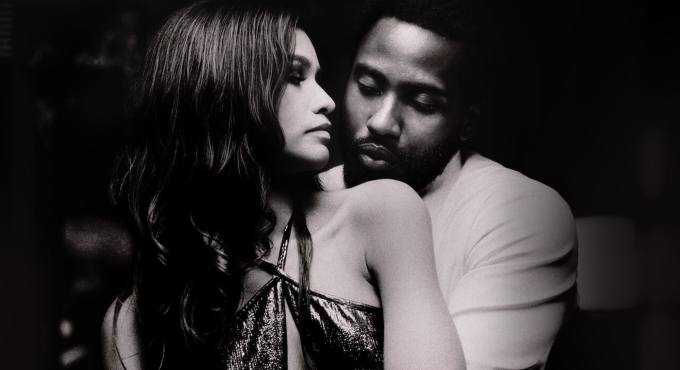
FLAWED BUT BEAUTIFUL: A REVIEW OF MALCOLM AND MARIE

I finally watched Malcolm and Marie on Sunday to see what the fuss is about. The film – a Netflix original featuring the actors Zendaya and John David Washington – went live on the streaming platform in the UK on February 5th. It has entered most people’s radar because of the controversy surrounding the age gap between the two main actors – with Zendaya being 24 and John being 36. However, much of this discussion happened before the film had even become available – many have now said the age gap is hardly noticeable in the film and if anything, is quite common for those who work in the film industry, like the character Malcolm does.

The film starts off with a couple coming back home from the screening of Malcolm’s film – of which he’s ecstatic about since it seems to have gone well. However, Marie doesn’t seem as happy and he wants to know why.

Viewers are constantly on the outside during this film…something epitomised in the film’s shots at the start, where the camera lingers outside and lets us peek into what Malcolm and Malcolm are doing inside the house. That feeling of looking from the outside never really leaves though and this is because, even as we get familiar with both characters – they each struggle to let us (and each other) in fully.

The Characters

Interestingly, it is hard to pinpoint the two characters fully- however, here is what can be gauged quite easily from viewing the film. Malcolm is a college-educated man, and a deep thinker. He definitely has short fuse though, as is seen from the explosive scenes of chaos that pop up frequently within the film. Although aware of the greys that exist in the world, he seems to see the world through a simple lens of black and white. He also seems to have ego the size of America itself – much to Marie’s annoyance.

Marie, we discover had a bad drug habit at a young age and presumably a troublesome childhood. She models although she once had dreams of acting which she eventually abandoned. She has a dry sense of humour but is deeply internally troubled – trying to escape a past which she still thinks haunts her. Most of the time she seems to brood in silence – a personality which noticeably contrasts Malcolm’s, a man who seems to be very expressive, a wearer of his heart on his sleeve.

What we witness during the film is what can only be a build-up of troubles that have accumulated during the discourse of Malcolm and Marie’s relationship. Although Malcolm mentions them being together at 70, you do genuinely wonder – will they ever make that stage? Behind every layer of love you sense between the two partners, there also seems to be underlying resentment – and vice versa. The entanglement between the two feelings leaves us uncertain of the direction of the relationship right until the last few minutes of the film.

Keeping it Real

Many tweets I scrolled through applauded Malcolm & Marie for its nuanced and realistic portrayal of a relationship. I can see why; the film focuses entirely on the nitty-gritty parts of a romantic relationship – the type most films typically only spend 10-20 minutes on. The insecurities that lurk in your mind. The ‘What-ifs’ that make you doubt your choice of partner. The feeling of being seen but not properly heard by your partner. These are all aspects touched on that are likely very common in romantic relationships and grow the longer you’re in them. The film provides a subtle lesson in the importance of communication and the danger of complacency in any relationship.

This review wouldn’t be doing the film justice if I didn’t mention its beautiful cinematography which I have to applaud. Its 60s-esque black and white appearance gives it a simple and refreshing feel. This simplicity it creates is compounded by the use of only two characters and one setting for the entire film.

Final Thoughts

Overall, the film has many strengths going for it; strong cinematography, great songs and acting, for starters. Zendaya’s knife scene and monologue towards the end from her bed are definitely stand-out scenes, too. However, the film felt slightly dragged out to me and towards the middle, boredom was niggling at my brain. Some films with this format – limited characters and scenes – do work (I recommend American Son on Netflix). However, the ‘will they/ won’t they stay together?’ was not enough to keep me entertained throughout. There needs to be some sort of movement in the plot line towards the end and the characters need to be fleshed out enough to get us to care for them. Neither seems to be the case with Malcolm and Marie unfortunately.

Yet, with Oscar seasoning soon arriving, will the film be included in any award nominations? Well, we’ll have to wait and find out…

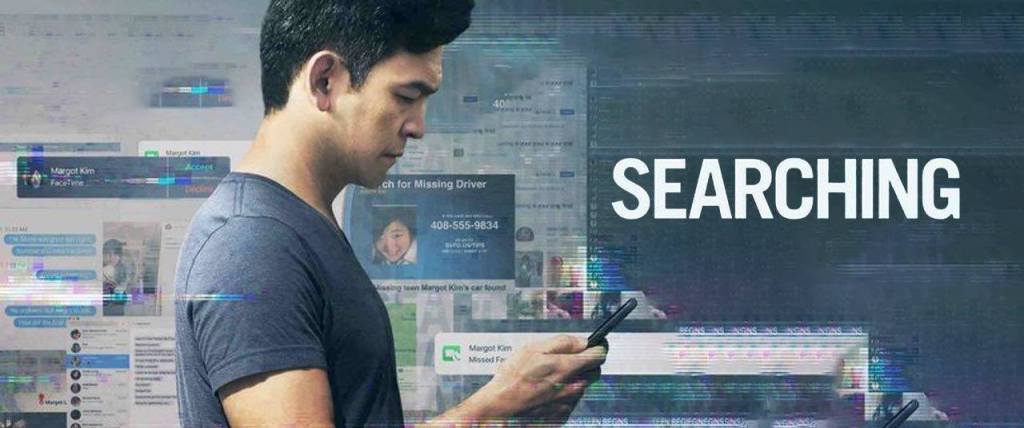
Searching: Layers of identity in the Digital Age

One of my most recent watches on Netflix was a film called Searching (2018). The film follows protagonist David Kim (John Cho) as he experiences every parent’s worst fear – their child going missing. Throughout the film he plays detective and partners with the police in order to find the truth and try and bring his daughter home. I remember wanting to watch this when it first came out but (annoyingly) it wasn’t showing at as many cinemas near me as I would have liked. And when it did it would be showing at weird times like 10pm and who is honestly going to the cinema at that time?!

Do we ever truly know someone?

This is a question I found hanging in the air as many thoughts passed through my mind as I watched Searching. Although I myself am not a parent I could imagine it is something many parents themselves wonder about their children, particularly in the day and age we live in. Social media means many people can carefully select the side of themselves they want exposed to their followers/ those that admire them. If you have watched the Netflix series One Day at a Time the mother of the family it chronicles in one episode discovers that her son has what is known as a ‘Finsta’ – a fake Instagram account specifically created to cater to the prying eyes of parents who love to monitor their child(ren)’s social media. This is not the case in Searching but it is a demonstration of in-authenticity that social media enables and how users can manipulate how they’re seen in followers’ eyes at will.

One thing that is the case for David though is that he discovers – devastatingly so – that he never really knew Margot, his only child. I can only imagine that such a discovery would be a shock to the system of a parent; it brings into question trust, arouses fear and often threatens the very foundation of a maternal or paternal relationship. David’s daughter, Margot is a loner who often eats lunch alone and fails to associate with a group of friends. This unfortunately creates much difficulty in David’s investigation since he is unable to find any close friends that would know details about Margot’s whereabouts. Many dead ends occur and as a viewer you can feel David’s bubbling frustration as well as the thought lurking somewhere in the back of his mind – that she may no longer be alive. It is evident that part of the reason for the disconnect between David and Margot is maybe generational. David, as a parent from a previous generation is slightly in the dark about the availability of social media forums. At one point he’s led to his daughter’s tumbler and reacts in a way that shows he’s never heard the platform’s name in his life. This gap in knowledge may be frustrating for parents once they know it’s there but many children actually find it beneficial.

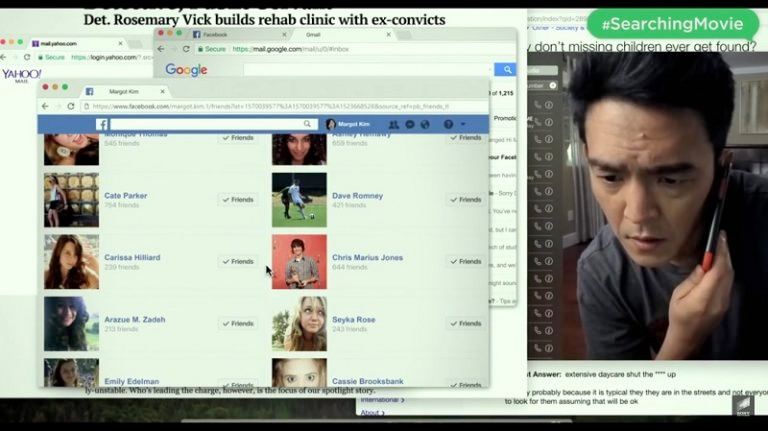
David desperately looking through Margot’s Facebook friend’s to find a lead on where she is.

Keeping to the theme of truly knowing someone, no one is who they seem in this theme which leaves room for several plot twists at the end of this film. Since Margot is a loner it means that the film cleverly avoids the solid formula of a whodunit. This is simply because the pool of people to suspect is so small that the possibility of stranger being involved almost makes more sense. It also means we see David reach several dead ends in his self-fuelled investigation to find her.

Interestingly, a significant proportion of the film takes place online. We are given all round access as David, for example attempts to log into his daughter’s social media, FaceTimes various contacts and uses google maps to access a location he wants to visit. I’m personally a low-key fan of tech interactions being shown on screen – i.e. seeing texts on screen between characters. It creates a transparency that I appreciate and helps to avoid any confusion or misunderstandings within the storyline. Of course, I can understand the devil’s advocate position may be that it doesn’t leave room perhaps for interpretation. Nevertheless, it means we’re learning information in real time along with David himself as he discovers information. The only thing I found slightly unrealistic was that David was able to access somehow to his daughter’s social media. Something tells me that most parents wouldn’t find it that easy or even succeed at all if the situation required for them to access their child’s social media accounts. Especially if they’re as close to their child as David is to Margot (which is not at all.)

I’m not too sure about the ending since I think I saw part of it coming. I wouldn’t outright call it ‘bad’ but there is definitely room for improvement. Overall, I enjoyed the film; there’s enough going on for you to stay gripped and guessing – just not till the end since you’ll likely see that coming before you reach it.

An Honest Review: American Son

Hey Guys,

I decided to mix it up a bit and write a film review today.

American Son poster
Image source: https://uk.newonnetflix.info/info/81024100

Quick Synopsis: At the start of the film we meet a concerned mother (Kerry Washington, best known from the show Scandal) who is waiting at the police station to enquire about her child. Later on, the father (Steven Pasquale) joins the picture and together they wait to find out the mystery of where their child is. It’s worth noting before I start my review that race matters in this film. Kerry’s character is a black psychology lecturer married to a white FBI officer, and together they have a mixed-race child.

My Thoughts:

A lot of ground is covered- but beautifully so in this film. It’s easy at first to think of it as a 3D case study of police brutality. But more lurks beneath the surface; through the husband and wife interactions more is explored regarding the intricacies of interracial relationships, being mixed race/ black in America, discrimination and parenthood.

What makes this film quite unique is that it doesn’t have a big cast (only around 4 actors) and the location is the same throughout. So from a distance, it would be easy to assume not much is going on. However, we learn an awful lot about the characters as time goes on and it’s those revelations that shape the film and (fairly slow-moving) plotline. Ultimately, whilst distracting us from the hanging question ‘what happened to the son?!’.

I was in awe of the acting, you could feel Kerry’s character’s pain which helped to amplify the tension. It might sound dramatic but your heart does hurt several times throughout the film for her. Also, the push- and pull nature displayed between the spouses throughout the film, made an intriguing watch.

Overall, I would give this film an 8.5/10. A tense watch (not sure I would handle seeing it on the big screen) so perfect for Netflix, which it is available to watch on.


Cutting through the noise

You’re enough. You’re blessed. You’re fabulous. In fact, you’re pretty darn amazing. You may not see it from time to time and sometimes the negative thoughts become like a dark haze, causing your amazing-ness obscure from view. But trust me, it remains a fact- so never forget that.

I write these words for anyone who is going through a rough patch and needs to hear it. But I also write these as a note to myself. Recently feelings of self-doubt and insecurity have been slowly flooding the walls of my mind and it has honestly felt quite tiring and unbearable at times. But insecurities are like that, they can end up silently leeching your energy and you won’t even know until you have none left. A good visual image to imagine how it feels is a cliche film scene where the female character enters the bathtub and submerges herself in the water. There’s a deafening pause as you wonder if she will arise again and choose life. And she always does. Gasping for air and slightly panicked, but she always does.

In the same way, when flooded with the thoughts we have to come back fighting. It’s definitely hard, but equally as possible. I believe that for every deafening feeling of self-doubt we have God is screaming even louder the words I started the blog with. Constantly. All the time. We just have to make the active choice to cut through the noise and listen. Over the voices of society or our peers. But most importantly, over the voices of ourselves.

La La Land-an honest review

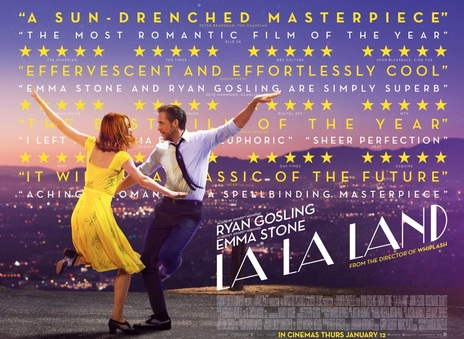
la-la-land

This film swept the floor at the Critic’s Choice Movie Awards, Golden Globes AND the Academy Awards (Oscars). Naturally, I therefore had high expectations. For those yet to see it, I’ve decided to do an honest breakdown of what I thought.

La La Land stars Ryan Gosling (Sebastian) and Emma Stone (Mia), who have in the past starred together in the romantic comedy Crazy, Stupid Love. The banter between these two characters made me smile throughout. Although, I’ve only really seen Gosling play reserved characters, Stone seemed in her zone with her character Mia who is goofy, passionate and dreamy. The scene where she is dancing to the music Gosling’s jazz ensemble is playing, was a great highlight.

Of course, this is a musical so it wouldn’t make sense for me to review it w/o mentioning how I felt about the vocals and soundtrack. Emma and Ryan don’t have the most exceptional voices in the world but I felt this made it sincere and translated the emotion much better. For soundtracks buffs I would recommend ‘City of Stars’ by Gosling and Stone and ‘The Fools who dream’ by Stone.

Throughout the film bright vivid colours flood the senses, mixed with nice American scenery. This gives a fantasy element to it all- a feeling sealed by the repeated scene of the two main characters dancing along a star studded background. This is certainly a film built for aesthetics and that ‘feel good’ factor- there (to me) isn’t any hidden or embedded meaning we should be looking for. I state this specifically because before watching the film I did read a review talking about the White erasure of Jazz’s black history. Watching it now, I disagree simply because I take La La Land to be a surface level film. It wasn’t trying to enact history and therefore does not need to carry the burden of historical accuracy.

Personally, I saw the film as a fight between reality and dreams, with Mia and Sebastian’s relationship on the border of the two. Mia tries throughout the film to reconcile her dreams with reality in terms of her relationship with Sebastian and her theatrical dreams. In contrast, Sebastian puts his dreams on hold when reality calls.

Overall, this film certainly makes an enjoyable watch; I would say 4.8/5. My only criticism would be that there could have been a clearer direction for the film in terms of plot. I can’t even say the plot’s quality is sacrificed for character development because I didn’t see huge character transformation (of even Mia or Seb) within the film. I mean, yes, their circumstances definitely do change by the end but whether they themselves do is not really known. Nevertheless, despite the deliberate uncertainty at the end you can leave the cinema feeling satisfied; which is all that matters in the end, right?

*Picture from: http://www.empirecinemas.co.uk/synopsis/la_la_land/f5293 *